
Our methodology
How we build our quizzes
We want quizzes to be fun, and we also care whether every result holds up. This page explains the research behind the questions, how scores are calculated, how reports are written, and, just as honestly, what a quiz can't tell you.
Last updated October 2026
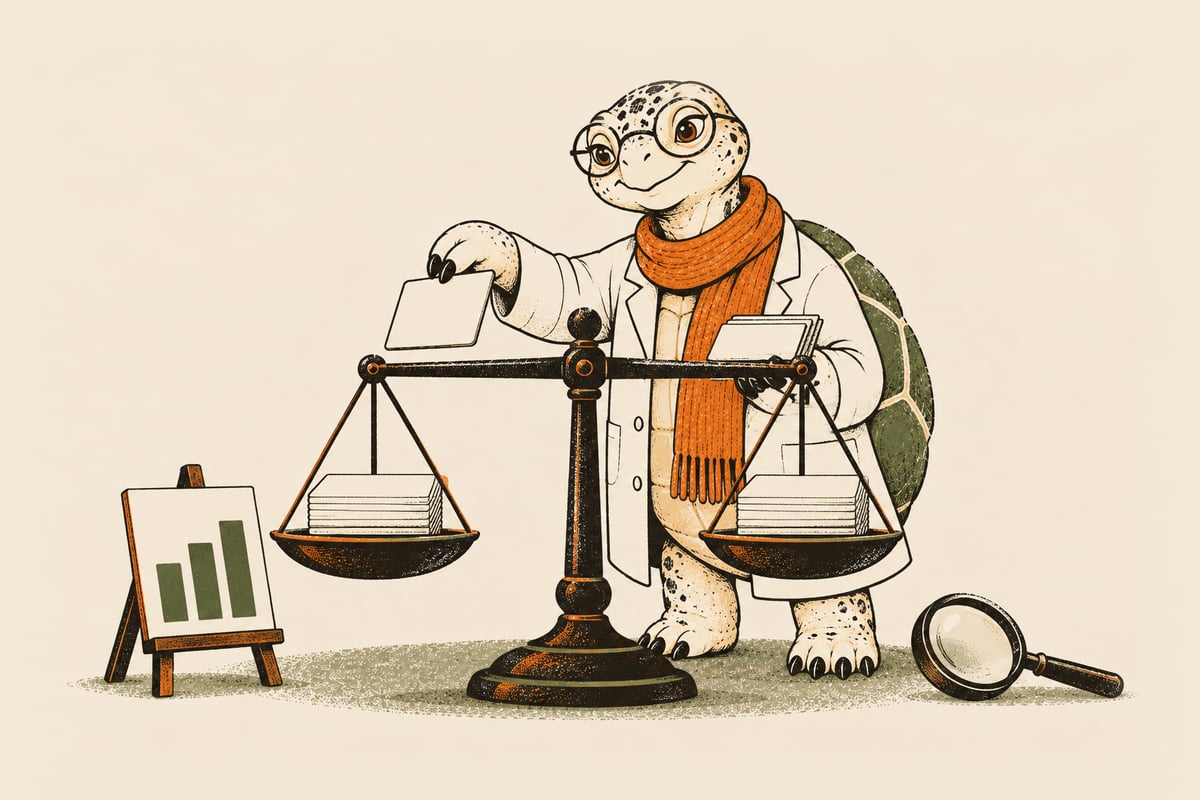
Four design principles
Grounded in research
Psychology quizzes draw on published research and established frameworks. When a quiz is purely for fun, we say so.
Original questions
Written from everyday situations, never copied from copyrighted questionnaires.
Fixed scoring
Our server scores with fixed rules, so the same answers always give the same result.
Plain language
Every dimension is explained in everyday words, with no jargon and no filler.
The theory behind them
Quizzes on the site fall into three groups, each with a different kind of basis.
Quizzes based on psychology research
These quizzes build on concepts that psychologists have studied for decades. We design our own questions, scoring and reports; they are not copies of the original research questionnaires.
- Big Five (OCEAN)
- The trait model most widely used in personality psychology: openness, conscientiousness, extraversion, agreeableness and emotional stability.
- Big Five Personality Test
- Attachment theory
- Rooted in Bowlby's and Ainsworth's research on children and caregivers, later extended to adult romantic relationships.
- Attachment Style Quiz
- Holland's career interests (RIASEC)
- Six career interest types proposed by psychologist John Holland and widely used in career counseling.
- Career Interest Test (Holland Code / RIASEC)
- Multiple intelligences
- Howard Gardner argued that ability comes in more than one form. Talent Radar starts from his eight intelligences and adds creativity and aesthetics.
- Talent Radar
- Emotional intelligence (EQ)
- The ability to notice and manage your own emotions and to understand and respond to other people's.
- Emotional Intelligence (EQ) Test
- High sensitivity
- Sensory processing sensitivity, described by psychologist Elaine Aron: an especially fine-tuned response to stimulation and emotion.
- Highly Sensitive Person Test
- Love styles
- Six styles of love proposed by sociologist John Alan Lee, from romantic and playful to friendship-based and selfless.
- Love Style Test + Love-Brain Index
- Chronotype (morning vs. evening)
- A sleep-research concept describing your body clock's natural preference for early mornings or late nights.
- Chronotype Quiz: What's Your Sleep Animal?
Popular personality frameworks
Frameworks such as the 16 types, the Enneagram, Jungian archetypes, DISC and the four temperaments are hugely popular, but the research support behind them varies. We treat them as a shared language for thinking about yourself, not as precise scientific measurements.
Just-for-fun quizzes
Numerology, blood types, aura colors and quizzes like "Which dog are you?" come from cultural traditions or are simply for fun, and they have no scientific basis. We keep them in the "Just for fun" and "Numerology" categories. Enjoy them for what they are.
How questions are written
A good question makes you think of yourself right away.
Everyday situations first
We ask about moments you actually run into at work, in group chats, on trips and in relationships, instead of a list of abstract adjectives.
Written by us, never copied
Questions and reports are original. We don't reuse items from copyrighted questionnaires or borrow text from other sites.
Positively and negatively worded items
Scale-based quizzes mix positively and negatively worded items to reduce the bias of agreeing with everything.
Rewritten for each language
Each language version rewrites the questions and reports around local everyday life. It's not word-for-word machine translation.
How scoring works
The same answers always give the same result.
Scored on our server
Once you submit, our server calculates your score with fixed rules. Your browser doesn't decide the result.
No randomness
Scoring follows a fixed formula. Even when two types tie, the tie is settled by your answers themselves, not by chance.
Not generated by AI on the spot
Scores and reports come from our own rules engine, assembled from content written in advance, so you won't get a different wording every time.
Versioned scoring rules
Published scoring rules are never quietly changed. When something needs adjusting, we release a new version and convert past answers to it with an explicit mapping, then rescore them, so every record follows the same standard. Reports you have unlocked stay unlocked.
How reports are written
Every section has to be useful to you.
Conclusion first, then evidence
Reports go in this order: your result, scores and charts, what they mean, what you can do, and sharing last.
Every dimension explained
Each aspect a quiz measures is explained: what it means and what it looks like in everyday life.
No filler
Every section must add something new. We don't repeat the same point in different words or pad with empty pleasantries.
Charts always come with words
Charts show numbers or labels too, so meaning never depends on color alone.
Conclusion first, the rest only when you open it
Your conclusion and key scores are shown openly. Right now, the rest of the full report is also open for free, and is sent to your browser when you open the full-report page or once you’re an annual member.
Older reports get better too
Report layout and wording keep improving, and older results open in the latest version of the report.
How we review
Every quiz and article gets a second check by someone other than the writer before it goes live.
Every fact has a source
Numbers and claims about theory in reports and articles must match either the scoring code or published research. Anything that does not is cut.
Writing and review are separate
Finished content goes to a separate review that checks each point: whether citations are right, whether a claim goes beyond what the research supports, and whether anything contradicts the reader’s own scores.
Fixed checks before launch
Before launch we check that the language reads naturally, that there is no empty filler and that punctuation fits the language. For exclusive quizzes we also confirm the free part is a complete answer on its own.
We correct mistakes
When readers or we spot an error, we fix it and note the change in our update log. You can report anything that looks wrong through the contact page.
References
The frameworks in the theory section come mainly from the published work below. Our questions are newly written around these ideas; they are not the official instruments from these studies.
- Ainsworth, M. D. S., Blehar, M. C., Waters, E., & Wall, S. (1978). Patterns of attachment: A psychological study of the strange situation. Lawrence Erlbaum.
- Aron, E. N., & Aron, A. (1997). Sensory-processing sensitivity and its relation to introversion and emotionality. Journal of Personality and Social Psychology, 73(2), 345–368.
- Bowlby, J. (1969). Attachment and loss: Vol. 1. Attachment. Basic Books.
- Gardner, H. (1983). Frames of mind: The theory of multiple intelligences. Basic Books.
- Goldberg, L. R. (1990). An alternative “description of personality”: The Big-Five factor structure. Journal of Personality and Social Psychology, 59(6), 1216–1229.
- Hazan, C., & Shaver, P. (1987). Romantic love conceptualized as an attachment process. Journal of Personality and Social Psychology, 52(3), 511–524.
- Holland, J. L. (1997). Making vocational choices: A theory of vocational personalities and work environments (3rd ed.). Psychological Assessment Resources.
- Horne, J. A., & Östberg, O. (1976). A self-assessment questionnaire to determine morningness-eveningness in human circadian rhythms. International Journal of Chronobiology, 4(2), 97–110.
- Lee, J. A. (1973). The colours of love: An exploration of the ways of loving. New Press.
- McCrae, R. R., & Costa, P. T., Jr. (1987). Validation of the five-factor model of personality across instruments and observers. Journal of Personality and Social Psychology, 52(1), 81–90.
- Salovey, P., & Mayer, J. D. (1990). Emotional intelligence. Imagination, Cognition and Personality, 9(3), 185–211.
Limits & disclaimer
A quiz can help you sort your thoughts, but there are things it can't do.
It reflects how you see yourself
Self-report quizzes are shaped by your mood, circumstances and answering habits. The result is how you describe yourself right now.
Tendencies, not labels
It's normal for the same person to get different results at different times. Types and scores point in a direction; they aren't a fixed verdict.
Not a diagnosis, not for big decisions
All quizzes are for entertainment and self-discovery only. They are not a professional psychological, medical or career assessment and shouldn't be used for hiring, medical or other major decisions.
If you've been feeling persistently low or anxious, or have thoughts of harming yourself, please reach out to a doctor or mental health professional as soon as you can. In the US, you can call or text 988 to reach the Suicide & Crisis Lifeline; elsewhere, contact your local emergency number or a crisis line.
Privacy principles
Answering a quiz is personal. We only take what we need.
No name needed
You can take quizzes without signing up or giving your name or email.
Answers used only where needed
Your answers are used to generate your result, save your progress and produce anonymous statistics. They're never sold or used for ad targeting.
Sharing never includes your answers
Share images and links only show a summary of your result, never your individual answers.
Your data, your call
Once signed in, you can download your data or permanently delete your account and all its records.
Try a quiz for yourself
Take one and see whether the questions really feel like your life.